
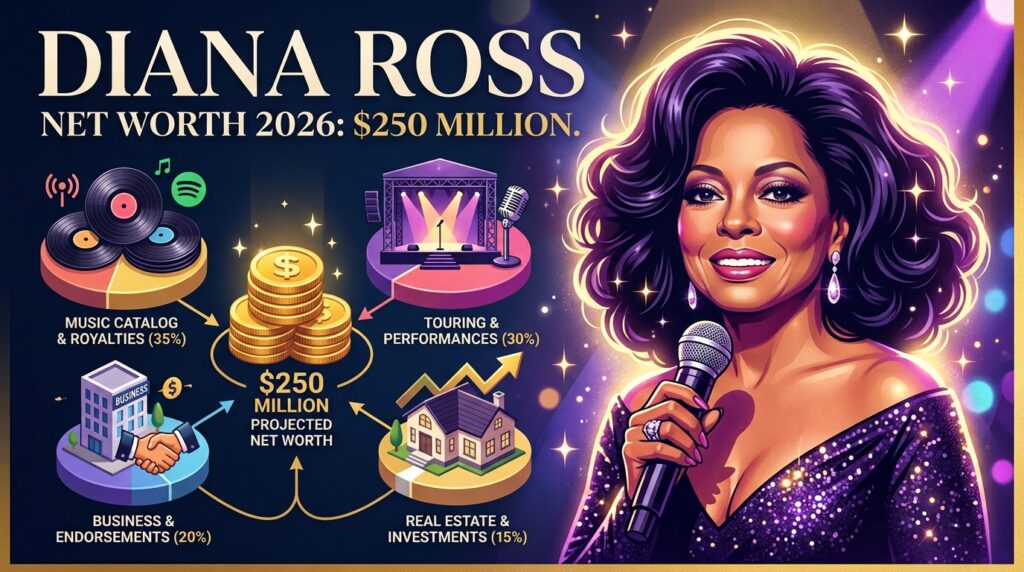

You hear the name Diana Ross and immediately picture sequins, massive hair, and absolute musical royalty. Yet behind the glamour lies a cutthroat financial reality that most pop-culture fans completely miss. Many artists from the 1960s died penniless due to predatory record contracts. Diana Ross beat the system, retaining an estimated $250 million empire through ruthless negotiation and fierce brand protection.
Understanding the true diana ross net worth requires looking past the Billboard hits and examining the mechanics of her financial empire. When she first signed with Motown, the financial terms favored the label heavily. She eventually realized that true wealth in the music industry does not come from selling records alone. It comes from owning your likeness, commanding massive touring guarantees, and expanding into Hollywood. By the 1980s, she had completely restructured her financial life, breaking away from the Berry Gordy machine to secure an unprecedented $20 million contract with RCA Records.
That single move redefined her earning potential forever. Today, her wealth is a complex mixture of ongoing royalty payments, high-yield real estate properties in Connecticut and Los Angeles, and an enduring brand that commands premium prices for private performances. She built a legacy that outlasted her peers. Unlike many of her contemporaries, she diversified her income streams early. We are going to audit the exact mechanics of her fortune, from her earliest royalty disputes to her modern-day asset portfolio.
The Foundation of Diana Ross Net Worth: The Supremes Era
Analyzing the early diana ross net worth means diving into the notoriously complex financial structure of Motown Records. In the early 1960s, the record business operated entirely differently than it does today. Artists rarely owned their master recordings.
According to the Detroit Historical Society, her early days with The Supremes were defined by flat weekly stipends rather than massive royalty checks. Motown functioned like an assembly line. The label paid for choreography, etiquette classes, and sequined gowns, but they recouped those costs directly from the artists’ earnings.
This accounting practice meant that despite selling millions of records, The Supremes saw very little actual cash early on. Standard royalty rates for groups at that time hovered around 3 to 5 percent. That tiny percentage was then split among the three group members.
Furthermore, the label held all publishing rights. The singers were treated as employees rather than business partners. To understand her current wealth, you have to realize she started from a massive financial disadvantage. She had to sing her way out of an exploitative financial model.
However, being the breakout star gave her unique leverage. Berry Gordy recognized her commercial appeal and positioned her as the focal point. This positioning eventually allowed her to renegotiate her standing within the company. She secured better terms as the group transitioned to “Diana Ross & The Supremes.” This subtle name change was actually a massive financial pivot. It established her as a standalone entity, setting the stage for her lucrative solo career.
Going Solo: How the Diana Ross Net Worth Skyrocketed
The massive expansion of the diana ross net worth officially began when she left The Supremes in 1970. Stepping out on her own meant she no longer had to split her performance fees or royalties. Her early solo albums generated massive sales, but the real financial shift happened behind closed doors.
She began demanding higher guarantees for her live performances. She also started taking a more active role in the production and publishing aspects of her music. The Songwriters Hall of Fame recognizes the immense value of owning publishing rights, something Ross became acutely aware of.
The ultimate power move occurred in 1981. After two decades with Motown, she shocked the music industry by leaving the label. She signed a seven-year, $20 million contract with RCA Records. Adjusted for inflation, that contract is worth over $65 million today.
This was an astronomical sum for a recording artist at the time. It gave her complete creative control and, most importantly, a much higher percentage of her album sales. She also established her own production company, Diana Ross Productions. This corporate entity allowed her to shelter income and write off massive business expenses.
By controlling her production, she captured the profit margins that previously went to Motown executives. She funded her own recording sessions and delivered finished products to RCA. This transition from “hired talent” to “business owner” is the exact mechanism that built her fortune. It is a strategy we frequently analyze in our weird wealth investigations, where ownership always trumps a high salary.
Touring and Live Performances Driving the Diana Ross Net Worth
If you want to know the true engine behind the diana ross net worth, look at her live performance history. Record sales generate great press, but touring generates raw, liquid cash. For over fifty years, she has commanded top-tier guarantees for her live shows.
In the 1970s and 1980s, her international tours grossed tens of millions of dollars. She consistently sold out massive arenas across Europe and Asia. Unlike modern 360-deals where labels take a cut of touring revenue, Ross kept the lion’s share of her box office receipts.
Her 1983 Central Park concert remains a legendary financial case study. Though initially rained out, the rescheduled free concert was funded by Showtime. She negotiated the broadcast rights brilliantly. She secured a massive payout from the network while maintaining ownership of the broadcast footage.
Beyond public tours, she tapped into the highly lucrative private events market. Billionaires and massive corporations routinely pay 1980s pop icons extraordinary sums for private performances. Industry insiders suggest her private booking fee starts at $1 million for a single evening.
These private gigs require minimal overhead. There is no massive stage production to transport and no ticket marketing budget required. She simply arrives, performs her classic hits for an hour, and collects a seven-figure check. This high-margin performance model is a primary reason her wealth remains so stable in 2026.
Hollywood Hustle: Box Office Bucks Impacting Diana Ross Net Worth
The diana ross net worth also benefited heavily from her strategic pivot into Hollywood. Starring in feature films opened up an entirely new revenue stream. Her Academy Award-nominated role in Lady Sings the Blues (1972) proved she was a bankable movie star.
She commanded high acting fees for subsequent films like Mahogany (1975) and The Wiz (1978). While The Wiz was initially considered a commercial disappointment, her upfront salary was guaranteed. Furthermore, her involvement in the film’s soundtracks generated massive secondary income.
Movie soundtracks were incredibly lucrative during this era. She often negotiated separate royalty rates for the music tied to her film projects. Her performance of “Theme from Mahogany (Do You Know Where You’re Going To)” became a massive number-one hit.
She effectively double-dipped on these projects. She earned a primary salary as an actress and ongoing royalties as a recording artist. This cross-collateralization of her talents shielded her from the financial risks of box office bombs. Even if a movie failed to turn a profit, the soundtrack sales ensured she walked away wealthy.
Her Hollywood ventures also elevated her brand prestige. Being a movie star allowed her to secure highly lucrative endorsement deals and appearance fees. It cemented her status as a global entertainment icon rather than just a singer.
Royalty Structures: A Diana Ross Net Worth Deep Dive
To truly understand the diana ross net worth, we have to look at the math of music royalties. Her extensive Diana Ross profile highlights a discography spanning six decades. Every time one of those songs is streamed, played on the radio, or used in a commercial, money changes hands.
The music industry operates on multiple royalty streams: mechanical, performance, and synchronization. Performance royalties are generated from radio play and public broadcasts. Because her catalog is filled with timeless, ubiquitous hits, her performance royalty checks remain massive.
Synchronization royalties occur when a song is placed in a movie, television show, or commercial. Hits like “I’m Coming Out” and “Ain’t No Mountain High Enough” are constantly licensed for advertising campaigns. These sync licenses can pay anywhere from $50,000 to $500,000 per use.
Below is an analytical framework breaking down how her revenue streams evolved over time. This comparison matrix highlights the shift from low-margin label dependency to high-margin independence.
This matrix proves why longevity requires evolution. She did not just survive the industry; she mastered its changing financial rules. She transitioned her income from active labor (recording) to passive assets (licensing).
Real Estate Holdings Anchoring the Diana Ross Net Worth
A significant portion of the diana ross net worth is locked up in ultra-premium real estate. Smart entertainers pull their cash out of the volatile music business and park it in physical assets. She executed this strategy flawlessly throughout the 1980s and 1990s.
Her primary residence for decades was a sprawling estate in Belle Haven, an exclusive enclave in Greenwich, Connecticut. Greenwich is notoriously expensive, serving as a haven for hedge fund managers and legacy wealth. She purchased a massive waterfront property there, which appreciated wildly over the decades.
She also maintained a significant footprint in Los Angeles. She has owned multiple mansions in Beverly Hills and the Hollywood Hills. California real estate provides excellent long-term equity growth. She frequently bought properties, held them for several years, and sold them for significant profit.
Real estate acts as a financial fortress for legacy artists. It protects their capital from inflation and provides borrowing leverage. If she ever needed liquid cash for a business venture, her property portfolio provided massive collateral.
These properties also offer significant tax advantages. The depreciation of physical real estate offsets the massive tax burdens created by her high royalty income. This sophisticated approach to tax strategy is exactly what separates wealthy celebrities from bankrupt ones.
Unconventional Assets Expanding the Diana Ross Net Worth
The diana ross net worth is not just stocks and houses; it includes fascinating unconventional assets. Unlike Ray J’s unconventional wealth built on consumer tech products, her alternative assets are purely rooted in high-end luxury.
She possesses a world-class collection of fine art and bespoke fashion. Her performance wardrobe alone is a historical archive worth millions. Custom sequined gowns designed by Bob Mackie in the 1970s now command exorbitant prices at auction.
She retains ownership of many of her iconic stage outfits. These are not just clothes; they are museum-grade historical artifacts. The Metropolitan Museum of Art and the Smithsonian actively curate items from this specific era of Black entertainment history.
Furthermore, her jewelry collection is legendary. She invested heavily in investment-grade diamonds and precious stones during periods of high inflation in the 1970s. High-end jewelry serves as an incredibly mobile, untraceable store of value.
She also built immense value in her personal brand trademarks. The name “Diana Ross” is a registered intellectual property. She controls the merchandising rights to her likeness, ensuring she profits from every t-shirt, poster, and commemorative item sold worldwide.
How the Diana Ross Net Worth Compares to Her Peers
Contextualizing the diana ross net worth requires comparing her to other legacy artists. Many singers from her era failed to cross the $50 million mark. Exploitative contracts and poor financial management decimated the wealth of many 1960s icons.
Aretha Franklin, the undisputed Queen of Soul, passed away with an estimated net worth of $80 million. While incredibly wealthy, Franklin’s estate was plagued by tax issues and missing wills. Ross, in contrast, built a highly structured, corporate approach to her wealth management.
Tina Turner amassed roughly $250 million before her passing. Turner achieved this through massive stadium tours in the 1980s and the eventual sale of her music catalog. Ross sits in the exact same financial tier as Turner. Both women used 1980s comeback eras to dictate unprecedented financial terms.
Modern pop stars like Taylor Swift or Beyoncé boast higher net worths, pushing past the billion-dollar mark. However, they operate in an era where artists control their master recordings from day one. Ross built her $250 million without the benefit of modern streaming economics or initial master ownership.
She achieved her wealth through sheer volume of hits, relentless touring, and strategic corporate pivots. When adjusting for the era she started in, her financial achievements are actually more impressive than many modern billionaires.
Is the Diana Ross Net Worth Still Growing in 2026?
You might assume the diana ross net worth is stagnant, but it continues to grow in 2026. Legacy artists with massive catalogs are experiencing a financial renaissance. The rise of music catalog acquisitions has pushed the valuation of classic hits to all-time highs.
Private equity firms and music funds are paying multiples of 15x to 20x annual royalty revenue to acquire legacy catalogs. While she does not own the original Motown masters, she possesses significant publishing interests and later-career master recordings. If she ever chose to sell her catalog rights, she could secure a massive nine-figure payday.
Furthermore, the vinyl resurgence has boosted physical album sales. Audiophiles are purchasing expensive, remastered editions of classic Supremes and solo albums. This physical media revival provides a lucrative, high-margin revenue bump.
She also continues to perform select, high-grossing shows. Her legacy tours are highly curated, playing premium venues with massive ticket prices. Fans gladly pay premium rates to see a living legend, ensuring her active income remains strong.
Finally, her wealth is actively managed by top-tier financial institutions. Even a conservative 5% annual return on a $250 million portfolio generates $12.5 million in passive income every year. Her fortune has reached terminal velocity; it generates more cash passively than she could ever spend actively.
Frequently Asked Questions
Did Diana Ross grow up rich?
No, she grew up in the Brewster-Douglass housing projects in Detroit, Michigan. Her family was working-class, and she built her entire financial empire from absolute scratch through her work at Motown Records.
How much did Diana Ross make with The Supremes?
During the early years, the group was paid a flat weekly salary of around $25. Even at their peak, restrictive Motown contracts meant they earned a tiny fraction of the millions of dollars their records generated for the label.
Does Diana Ross own her Motown masters?
No, standard Motown contracts dictated that the label retained ownership of the master recordings. Berry Gordy and Motown controlled the most lucrative assets of her early career, which is why she eventually left for RCA Records.
Who is the richest of Diana Ross’s children?
Tracee Ellis Ross is her wealthiest child, boasting an estimated net worth of $16 million. Tracee built her independent fortune through her long-running television roles on Girlfriends and Black-ish, alongside her successful haircare company, Pattern Beauty.
What is the biggest contract Diana Ross ever signed?
In 1981, she signed a record-breaking $20 million contract with RCA Records. This deal was unprecedented for a female artist at the time and fundamentally changed her financial trajectory.
Does Diana Ross still make money from touring?
Yes, she continues to perform live and commands incredibly high fees. She frequently books lucrative private performances and legacy theater residencies that generate millions of dollars with very low overhead costs.
The diana ross net worth is a masterclass in celebrity wealth management. She survived the financial meat grinder of 1960s Motown to emerge as a quarter-billionaire. If you are an entrepreneur looking for inspiration, study her 1981 RCA contract negotiation. She recognized her market value and ruthlessly cut ties with the system that built her to capture the profits she actually deserved.
You can apply this exact mindset to your own business ventures. Stop accepting flat fees when you should be negotiating for backend ownership. Start prioritizing assets that appreciate over time, just as she did with her massive real estate portfolio. Protect your intellectual property fiercely.
Disclaimer: The financial information and net worth estimates provided in this article are for educational and entertainment purposes only. We are not certified financial advisors. Wealth metrics are based on publicly available data, historical contract analysis, and industry estimates, which may not reflect private asset valuations or current tax liabilities. Always consult a licensed financial professional before making any investment decisions.